Query the law.
Real sources. Living graph.
OpenLegis turns Italian and European laws, decrees and parliamentary processes into a navigable knowledge graph, with precise citations to official sources. Free, for citizens, legal professionals and public administration.
Understanding the law shouldn't be a maze
Fragmented texts
Norms scattered across the Official Gazette, Normattiva, EUR-Lex and different databases: piecing together the full picture takes hours.
Constant changes
A decree amends, repeals or replaces articles of earlier laws. Knowing what is actually in force today is hard.
Opaque sources
Summaries and commentary often fail to cite the exact article: it becomes hard to verify facts and guard against misinformation.
One platform to read, verify and cite
Query Italian and EU norms
Constitution, codes, decrees and European law in a navigable graph. Every answer cites the exact article and original source.
Track legislative processes
Status of bills, signatories and parliamentary votes: follow a measure from filing to approval.
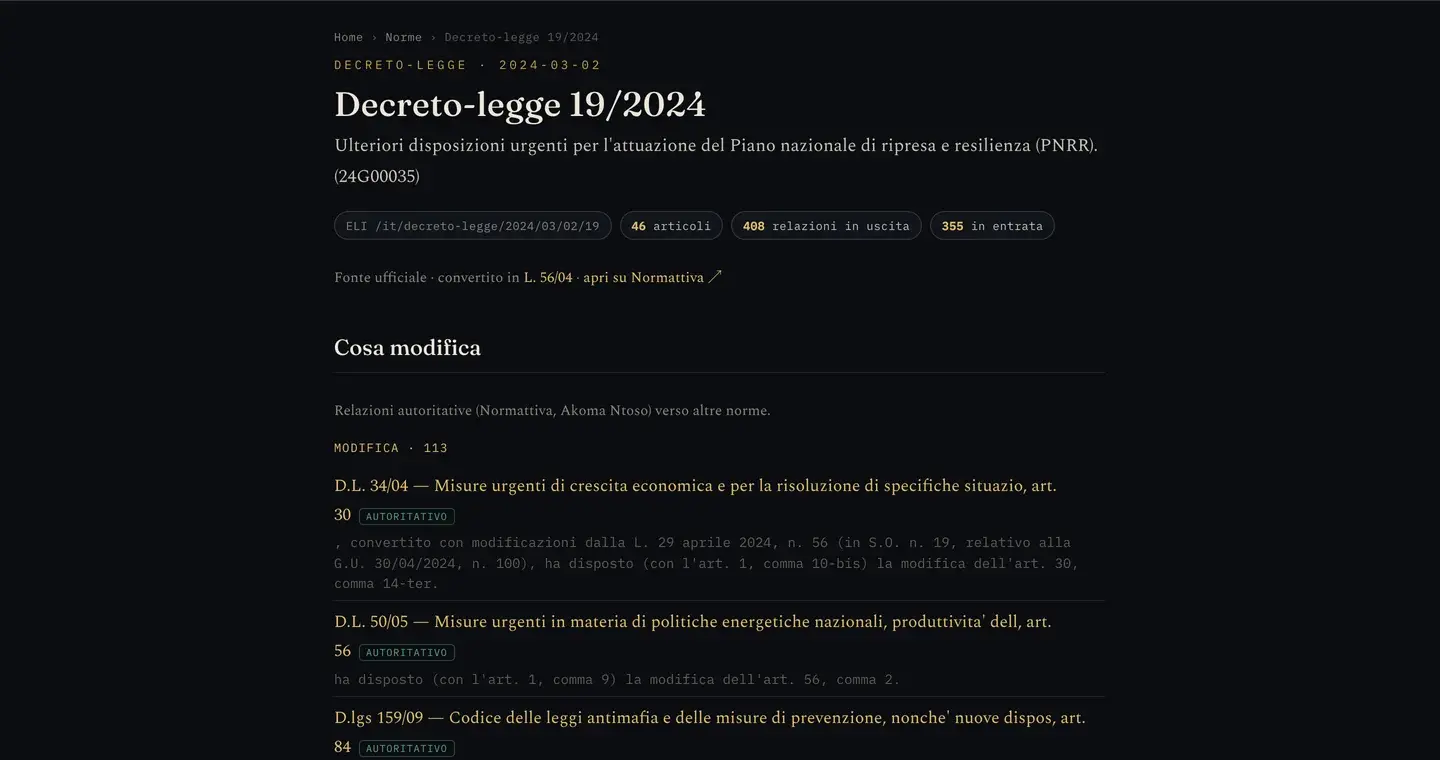
See what each norm changes
Identify which laws are amended, repealed or replaced by a decree, with links between the versions.
Linked public datasets
Italian and European open data connected to legal sources, for reproducible analysis and research.
From question to source, in three steps
Search
Ask a question in natural language, or start from a norm, a decree or a bill.
Navigate the graph
Explore the links between articles, amendments and parliamentary processes in the knowledge graph.
Verify and cite
Open the official source (Normattiva, EUR-Lex, Chamber or Senate) and cite the exact article.
An open method
OpenLegis does not train a model on a pile of PDFs. It first reconstructs the relationships between norms — what amends what, what repeals what — and only then brings in the agent: that is the difference between an answer that sounds confident and one you can check article by article. The data is already public, but it lives across inconsistent portals and half-answering endpoints; the work is in making it talk to itself. The method and the tools are those of OSINT: open sources, open standards, steps anyone can retrace.
Where the data comes from
| Source | What it opens | Standard |
|---|---|---|
| Normattiva | Consolidated legal texts and the graph of amendments | Akoma Ntoso · ELI |
| Camera e Senato | Parliamentary process, bills, votes | SPARQL |
| EUR-Lex | EU law and Court of Justice rulings | SPARQL · CELEX |
| Corte Costituzionale | Rulings since 1956 and norms challenged in pending cases | Open data |
| Cassazione e giustizia amministrativa | Supreme Court and administrative rulings | SentenzeWeb · CKAN |
| LightRAG | Constitution and codes: text, graph and semantic search | GraphRAG |
| CKAN | National, regional and European datasets | CKAN |
| Eurostat | Official statistics with value, period and source | SDMX |
| Gazzetta Ufficiale | Latest published acts | RSS |
| OpenPolis | Members of parliament, votes, decrees, bodies | REST |
The code is public
The connectors are open source: infrastructure that calls itself public has to be readable, reusable and open to challenge.
An MCP server that queries the official SPARQL endpoints of the Italian Chamber and Senate directly: 53 tools over the two ontologies. Both chambers model their data independently, with schemas that look alike and diverge in ways that make queries fail silently — hand-mapping them and documenting where they diverge is most of the actual work.
The same connector layer exposed as a Python MCP server, callable from any compatible assistant.
The limits come first
- The project works on public office holders and public data, never on private citizens.
- Source licences are respected, and declared.
- Every statement traces back to a citable source — ELI, CELEX, Akoma Ntoso. When the source is missing, OpenLegis says so instead of inventing one.
- No legal advice: OpenLegis lays out the facts and leaves the conclusion to the reader.